

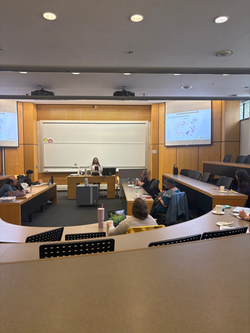
 Digital Feminist Network Summit (2025) |  Doctoral Summit Scholar, Academy of Criminal Justice Sciences (2024) |  American Society of Criminology (2024) |  Doctoral Summit Scholar, Academy of Criminal Justice Sciences (2024) |  Western Society of Criminology Conference (2020) |
|---|---|---|---|---|
 Academy of Criminal Justice Sciences (2024) |  American Society of Criminology (2024) |  Canadian Law and Society Association (2025) |
Research Interests
My research interests fall into three interconnected strands.
First, online radicalization, extremism, and digital cultures. I study how extremist ideas develop, circulate, and change across digital spaces, and how online environments can shape pathways toward violence. My work examines extremist narratives and communities across social media, alternative platforms, forums, podcasts, and manifestos. I use qualitative and computational methods, including topic modelling, emotion and sentiment analysis, text classification, and network analysis.
Second, gender, misogyny, and violence. A central focus of my research is the role gender plays in extremist movements and violent subcultures. I am particularly interested in misogyny as an ideology, grievance, and cultural framework that can connect different forms of extremism. My work examines the manosphere, gender-driven extremism, anti-feminist discourse, male grievance communities, and women's participation in anti-gender movements. I am also interested in how gender, identity, emotion, and perceived authority shape the communication and legitimation of harmful ideas.
Third, digital platforms, emerging technologies, and online harms. My recent work examines artificial intelligence, automated content moderation, platform governance, technology-facilitated gender-based violence, and violent online subcultures. I am particularly interested in how digital systems identify and respond to harmful content, including forms of harm that are contextual, coded, relational, or gendered. This work also considers what these challenges mean for public policy, prevention, and platform accountability.
Across these areas, my broader goal is to better understand contemporary forms of extremism and online harm while producing research that is useful for academic, policy, and public audiences.
Academic Bio
I am a SSHRC Canada Postdoctoral Research Award Fellow at the University of Toronto. I completed my PhD in Sociology at the University of Waterloo. My doctoral dissertation, Misogyny and Extremism Across Forums, Podcasts, and Manifestos: A Mixed-Methods Study, examined incel communities, manosphere podcasts, and more than 100 extremist manifestos using mixed and computational methods.
My doctoral research was supported by the Joseph-Armand Bombardier Canada Graduate Scholarship, the P.E.O. International Scholar Award, the Ontario Graduate Scholarship, and the Harry Frank Guggenheim Emerging Scholar Award. In 2026, I was selected as the Faculty of Arts nominee and a finalist for the Governor General's Academic Gold Medal at the University of Waterloo.
Before beginning my SSHRC CPRA Postdoctoral fellowship at the University of Toronto, I was a CIGI Digital Policy Hub Postdoctoral Fellow, funded by the Mitacs Accelerate program, where my research focused on online harms, artificial intelligence, platform governance, and digital policy.
My work has also involved extensive collaboration across academia, government, think tanks, and civil society. I have worked with organizations and research networks including the SIGNAL Network (Strategies for Intersectional Gender Justice Networked Action and Liberation), Canadian Network for Security, Extremism and Society (CANSES), VOX-Pol Network, Canadian Institute for Far-Right Studies (CIFRS), and the International CyberCrime Research Centre (ICCRC).
My research has been published in peer-reviewed journals, edited collections, conference proceedings, government and policy reports, and public-facing outlets. I regularly present at academic conferences and invited talks and contribute to public conversations on extremism, misogyny, online harms, and digital policy.
I have also taught courses in sociology, criminology, violent extremism and terrorism, and research methods. Mentorship remains an important part of my academic work, and I have supervised and supported students working across qualitative, quantitative, and computational research.
About Me
My academic work sits across sociology, criminology, computational social science, and public policy. I am especially interested in research questions that cross disciplinary boundaries and benefit from combining different methods and perspectives.
Outside of research and teaching, I enjoy gardening, experimenting with new recipes, and spending time with family. I care deeply about mentorship, public engagement, and making academic research accessible beyond universities.
For collaborations, consulting, or just to connect, please feel free to reach out to me.